

Mega Evolution is where this whole era begins — the set that brought a beloved mechanic back to the game after more than five years away, introduced an entirely new rarity tier in the process, and did it with two of the most requested Pokémon in the franchise leading the charge. Here's the full breakdown.
Field | Details |
|---|---|
Release Date | September 26, 2025 |
Era | Mega Evolution Era (the set that opened it) |
Set Code | ME01 (MEG) |
Set Size | 188 cards (132 main set + 56 secret rares); 320-card master set with reverse holos |
Set Type | Main Expansion (era-opening) |
JP Equivalent | Two source sets combined: Mega Brave (M1L) and Mega Symphonia (M1S), both released in Japan August 1, 2025 |
Story Tie-In | The mechanic's return to the core card game, timed alongside renewed Gen 6 attention ahead of Pokémon Legends: Z-A |
Regulation Mark | I (the mark the whole Mega Evolution era launched under) |
Standard Rotation Date | Active — Standard legal, not yet rotated |
Collector Interest Grade | A- (88/100) — see breakdown below |
What Made It Special
Mega Evolution is the first main set of an entirely new era — the first release after Scarlet & Violet's three-year run, and the set that brought the Mega Evolution mechanic back to the trading card game for the first time since 2019. It combines two Japanese source sets, Mega Brave and Mega Symphonia, into a single English release, and in doing so introduces something the game had never had before: the gold-etched Mega Hyper Rare, a rarity tier built specifically to give Mega Evolution Pokémon ex an even higher ceiling than a standard Special Illustration Rare. Ten Mega Evolution Pokémon ex debut here, one for each energy type, with Mega Lucario ex and Mega Gardevoir ex as the clear headliners.
Top Chase Cards
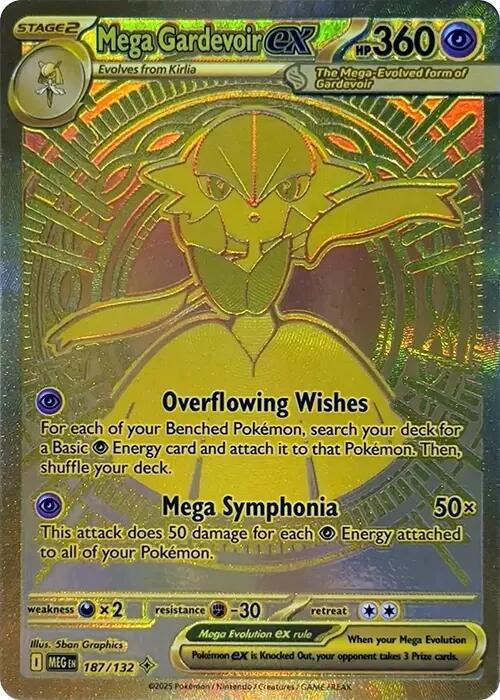
1. Mega Gardevoir ex (Mega Hyper Rare, #187) — the single hardest pull in the set, and one of only two cards anywhere carrying this brand-new rarity tier at launch. IGN's release coverage called the standard Gardevoir illustration rare "the crown jewel of the set" before this even more extreme treatment existed.
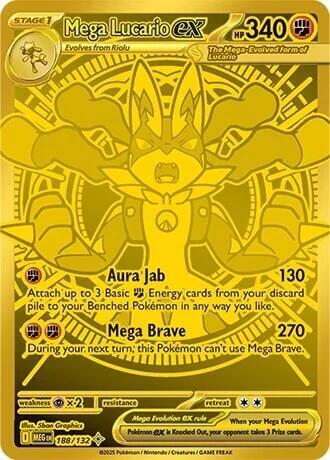
2. Mega Lucario ex (Mega Hyper Rare, #188) — the other half of the set's Mega Hyper Rare pair, and the card most associated with the tier's debut given its numbering sits at the very top of the checklist.
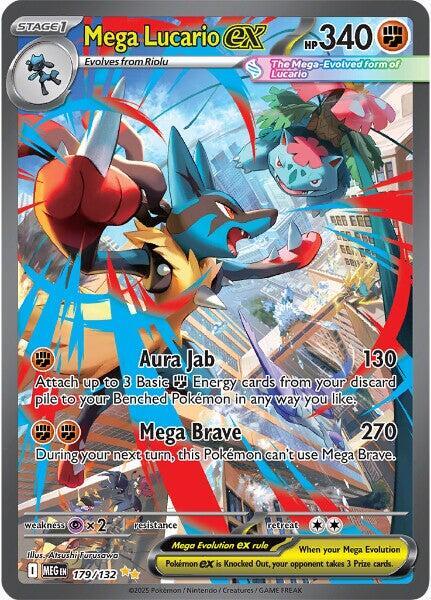
3. Mega Lucario ex (Special Illustration Rare, #179) — the more attainable of the two Lucario treatments, tracking $190–280 and one of four total printings of this specific character across the set's full rarity ladder.
Pull Rates
Rarity Tier | Approx. Odds |
|---|---|
Special Illustration Rare (Mega Gardevoir ex / Mega Lucario ex specifically) | ~1-in-250 packs |
Mega Hyper Rare (either of the two) | ~1-in-1,260 packs |
Community-tracked estimates, consistent with the era-wide Mega Hyper Rare rate this set itself established. Individual results vary — these are large-sample averages, not guarantees.
Notable Secondary Pulls
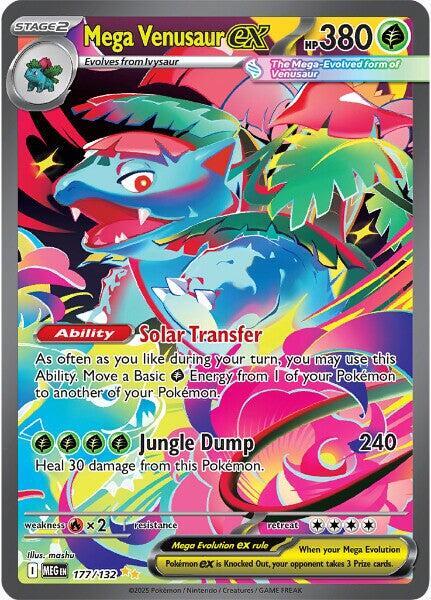
Mega Venusaur ex (Special Illustration Rare, #177) — tracking $160–245, one of eight remaining Mega Evolution Pokémon ex rounding out the set's headline lineup.
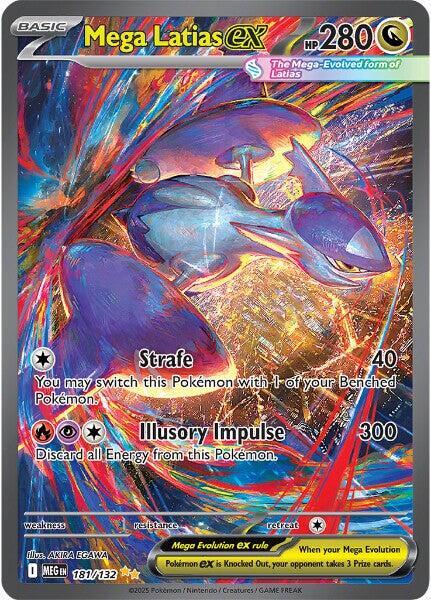
Mega Latias ex (Special Illustration Rare, #181) — tracking $80–85, illustrated by Akira Egawa.
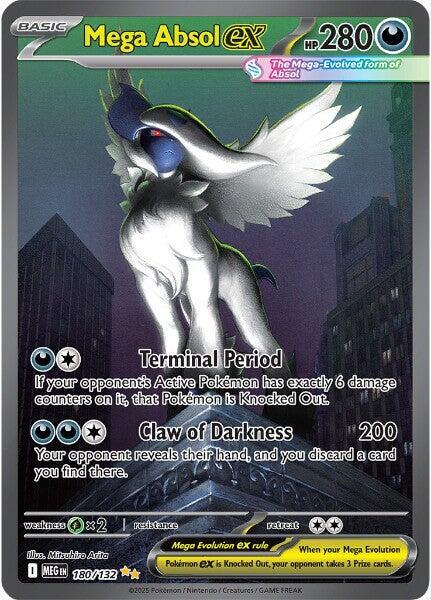
Mega Absol ex (Special Illustration Rare, #180) — tracking $60–100, illustrated by Mitsuhiro Arita, alongside Mega Kangaskhan ex rounding out the strongest of the remaining special illustration rares.
The set also reintroduces Mirror Holofoil variants for the first time since the Black & White era, and debuts full-art Ultra Rare treatments for Item, Pokémon Tool, and Stadium cards — Night Stretcher and Rare Candy were the first of these revealed.
How It Compares
As the set that opened the Mega Evolution era, Mega Evolution set the template every release since has followed — the Mega Hyper Rare tier, the Special Illustration Rare ladder for Mega ex Pokémon, the whole rarity structure. Reception at launch was genuinely strong, with prerelease turnout and Enhanced Booster Box demand both described as comparable to Hidden Fates-level excitement, and it holds up well against the era's two other standout releases, Ascended Heroes and Phantasmal Flames, even without either set's specific single-character mania (Ascended Heroes' God Pack concept, Phantasmal Flames' Charizard). It sits well ahead of the era's later, more mixed-reception releases — Perfect Order, Chaos Rising, and Pitch Black.
Collector Interest Grade Breakdown
Factor | Weight | Score |
|---|---|---|
Community Reception | 35% | 88 |
Chase Card Desirability | 25% | 90 |
Competitive Relevance | 15% | 80 |
Artistic / Design Merit | 15% | 92 |
Franchise / Nostalgia Pull | 10% | 90 |
Total & Grade | 88 | A- |
Mega Evolution earned its strong score by genuinely delivering on a five-year-anticipated comeback. Community reception was consistently described as the strongest new-series launch since Sword & Shield's base set, with prerelease turnout and immediate Enhanced Booster Box sellouts backing that up. Chase Card Desirability benefits from real scarcity math working in the set's favor — a brand-new rarity tier debuting at odds this steep created instant, durable demand. Artistic merit scores highest of all, driven by genuine critical praise for the Gardevoir and Lucario illustrations specifically. Competitive relevance is real but more modest — Mega Evolution Pokémon ex Rule cards (three prizes on knockout) demand careful deck-building, keeping this set a notch below the era's most format-defining releases.
Bottom line: this is the set that made the whole era's chase-card economy possible, and its own headline pulls have held up as durable, desirable cards rather than launch-hype fades — a legitimately strong foundation set, not just a historically important one.
Special Notes
Mega Evolution is genuinely unusual among Mega Evolution era sets in combining two separate Japanese releases (Mega Brave and Mega Symphonia) into one English set — every other release in the era maps to a single Japanese counterpart. Per PokeBeach's coverage, only the Illustration Rares of Riolu and Alakazam were cut from the English version, repurposed instead as Elite Trainer Box promos.
Fun Facts / Trivia
This is the set that introduced the Mega Hyper Rare tier to the Pokémon TCG — every Mega Hyper Rare printed since traces back to the treatment debuting here.
Mega Evolution Pokémon ex Rule cards award three Prize cards on knockout, rather than the standard two for most ex cards — a real, meaningful competitive-play distinction.
Scoring Methodology: The Collector Interest Grade is calculated from five weighted factors — Community Reception (35%, sourced from collector/enthusiast sentiment rather than pricing), Chase Card Desirability (25%), Competitive Relevance (15%), Artistic/Design Merit (15%), and Franchise/Nostalgia Pull (10%) — scored 0–100 and mapped to a letter grade. This grade reflects hobby and collecting interest only and is not investment advice.
Pricing: Prices link live to TCGPlayer and update independently of this article.
Affiliate Disclosure: Tome Collective may be compensated if you make a purchase through links in this article.