


The Story So Far
Ursula's Return put a specific villain at the center of the story for the first time — the sea witch's power grab threatening to rewrite the Illuminary's careful order from within. The set established a template that would recur: a single corrupting will, drawing on the Illuminary's own magic to accumulate power no individual glimmer was supposed to hold. Ursula failed, but the pattern she established — a hidden force growing unchecked until it threatened the whole — would become the Vine storyline's backbone, applied not to a person but to something older and stranger.
Field | Details |
|---|---|
Release Date | May 3, 2024 (local game store prerelease); May 17, 2024 (wide retail) |
Era | Enchanted Era |
Set Code | Set 4 |
Set Size | 205 main-set cards plus 18 Enchanted (223 total) |
Set Type | Main Expansion |
Franchise Tie-In | Lorcana's first set built around a named villain's return arc; Encanto gets its own starter deck alongside a broader Little Mermaid focus |
Format Legality | Rotated out of Core Constructed (September 2025); remains legal in Infinity |
Standard Rotation Date | Rotated, September 2025 |
Collector Interest Grade | B- (70/100) — see breakdown below |
What Makes It Special
Ursula's Return was Lorcana's first set built around a specific villain's comeback narrative, and it leaned into that with real structural ambition — a bundled cooperative side-game mode alongside the standard competitive product. Its most notable footnote, though, is competitive rather than collectible: Bucky - Squirrel Squeak Tutor became powerful enough (discarding multiple cards from an opponent's hand as early as turn 2) that Ravensburger issued an emergency errata, raising his cost to 3 and removing Ward, effective with Shimmering Skies. TheGamer's contemporary review captured real anxiety about the set at launch, worried it could "replace a healthy meta with a significantly worse one" after Into the Inklands' widely-loved competitive scene — and fan reaction to the errata itself was genuinely mixed, with some players preferring a ban to a mid-cycle rules change.
New to This Set
Franchise debuts: Encanto makes its Lorcana debut, bringing the entire Madrigal family — Mirabel, Bruno, Julieta, Félix, Dolores, and Luisa — along with a new Madrigal family classification.
Narrative theme: For the first time, a single corrupting will threatens to rewrite the Illuminary's order — a named villain's rise that sets the tone for the sets to come.
Top Chase Cards

Ariel - Sonic Warrior (Enchanted) — the set's real headline chase, tracking $382–429, with graded copies selling well above that. Not to be confused with Ariel - Treasure Collector, a lower-rarity printing.

Cinderella - Melody Weaver (Enchanted) — the real second by price, tracking $345–382, praised for its striking golden-swirl artwork.

Minnie Mouse - Musketeer Champion (Enchanted) — rounds out the real top tier; Minnie's first musketeer treatment since Mickey debuted his in The First Chapter.
📊 Live Chase Card Prices
Prices via TCGPlayer · Updated every 12 hours
Notable Secondary Pulls
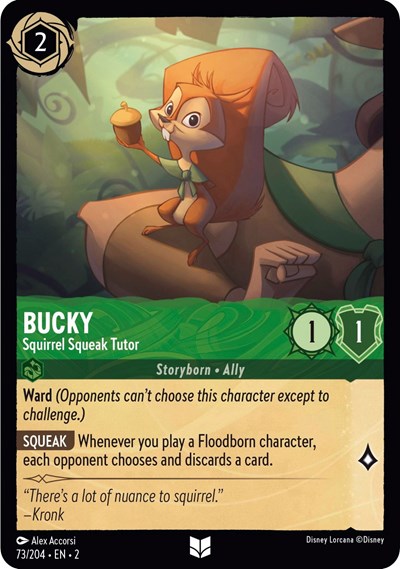
Bucky - Squirrel Squeak Tutor (Legendary, originally printed in Rise of the Floodborn) — not native to this set, but its story belongs here: the card's competitive power level during Ursula's Return's format drew the errata that defines this set's mechanical footnote.

We Don't Talk About Bruno (Enchanted) — tracking around $175, the set's Encanto song card and one of the most recognizable tracks in the source film.

Diablo - Devoted Herald (Enchanted) — a niche pull for Sleeping Beauty and Maleficent-adjacent collectors.
Pull Rates
Ravensburger has never officially published pull rates. Community estimates for this set generally track the catalog-wide ~1-in-96-pack Enchanted consensus.
Pull | Estimated Rate |
|---|---|
Enchanted (any) | ~1 in 96 packs (catalog-wide community estimate) |
These are community estimates, not official rates.
How It Compares
Ursula's Return follows Into the Inklands and represents a return to more typical print levels, which helped its chase cards hold value more normally. But the Bucky controversy and its more anxious contemporary reception hold it back — across the full 13-set catalog, it ranks 10th, in the lower third: only Shimmering Skies, Reign of Jafar, and Into the Inklands score lower. Its most memorable footnote remains competitive rather than collectible — Bucky's post-release errata is one of the more notable balance interventions in Lorcana's history.
Collector Interest Grade Breakdown
Factor | Weight | Score |
|---|---|---|
Community Reception | 30% | 60 |
Chase Card Desirability | 25% | 80 |
Competitive Relevance / Playability | 20% | 60 |
Artistic / Design Merit | 15% | 80 |
Franchise / Nostalgia Pull | 10% | 75 |
Total / Grade | 70 — B- |
With Community Reception restored, Ursula's Return actually drops slightly to 70 (from 73) — the real contemporary reception was more anxious than "solid but unremarkable," driven directly by the Bucky problem that led to the errata, and mixed fan reaction to the fix itself. Chase Card Desirability corrected upward once the real headline card (Ariel - Sonic Warrior, not Treasure Collector) is properly accounted for — $382–429 is a genuinely strong chase value. Competitive Relevance stays soft, a fair reflection of a set remembered as much for a balance failure as for its actual card design.
Special Notes
Ursula's Return rotated out of Core Constructed in September 2025. Its bundled cooperative side-game mode was a first for the franchise and hasn't been repeated in quite the same form since.
Fun Facts / Trivia
Bucky - Squirrel Squeak Tutor received an official errata shortly after release — cost raised to 3, Ward removed — one of the few cards in Lorcana's history to require a post-launch balance adjustment.
This was the first Lorcana set to bundle a cooperative game mode alongside the standard competitive product.
Ursula's Return marked the first time a villain's name headlined a Lorcana set title.
Scoring Methodology: The Collector Interest Grade for Lorcana set overviews is calculated from five weighted factors — Community Reception (30%), Chase Card Desirability (25%), Competitive Relevance/Playability (20%), Artistic/Design Merit (15%), and Franchise/Nostalgia Pull (10%) — scored 0–100 based on documented facts and sourced critical/community reception, mapped to a letter grade. This grade reflects hobby and collecting interest only and is not investment advice.
Pricing: Prices link live to TCGPlayer and update independently of this article.
Affiliate Disclosure: Tome Collective may be compensated if you make a purchase through links in this article.