

Reading the Symbol
The Pokémon Company's own card database recognizes 21 rarities across the game's full history — but only 9 of those show up regularly in sets printed since March 2023, which is what this guide focuses on. Worth knowing what you're actually opening: a standard Scarlet & Violet-era booster pack holds 12 cards — 4 Commons, 3 Uncommons, a guaranteed Reverse Holo, one "hit" slot that could be a second Reverse Holo, an Illustration Rare, a Special Illustration Rare, or a Hyper Rare, one "rare" slot that could be a Rare, Double Rare, or Ultra Rare, plus a Basic Energy and a code card. One practical tip: the silver-foil star symbol on some Ultra Rare and Secret Rare cards prints almost invisibly against a white card background — if a card looks symbol-less at a glance, check again before assuming it's unmarked.
Every Pokémon card prints its rarity symbol in the bottom corner, next to the collector number. That symbol — not the set icon next to it, a common mix-up — is what actually tells you the rarity. Worth knowing before diving in: the collector number itself (formatted XXX/YYY) can be misleading, since YYY doesn't always reflect the true card count — Secret Rares get numbered beyond the set's advertised total. And a handful of special, non-booster products skip the rarity symbol entirely, using a colored silhouette of the featured Pokémon instead. For a direct visual reference showing each symbol itself, TCGPlayer's own rarity guide is a solid, official resource. The system covered below has grown enormously since 1999, but it's grown in layers, and each layer maps to a specific era. Here's the full picture as it stands today.
The Original Three, Still the Foundation
Three symbols have marked Pokémon cards since Base Set and haven't changed since:
Rarity | Symbol | What It Means |
|---|---|---|
Common | Black circle | The most frequently printed cards in any set — several per pack, usually Basic Pokémon, Trainer Items, and basic Energy |
Uncommon | Black diamond | A step up — Stage 1 Pokémon, Supporter cards, and useful Items |
Rare | Black star | One per pack, non-holo. The classic "basic rare" tier |

Mewtwo (Scarlet & Violet 151, #150/165) — a clean, current-era Rare Holo example.
Rare Holo uses the same black-star symbol as Rare, but with a holographic foil pattern — the "shiny card" collectors have chased since the game's earliest days. Reverse Holo is worth calling out separately: it's a foil finish, not a rarity of its own. It can apply to a Common, Uncommon, or Rare, inverting the foil pattern so the card frame and text box shine while the artwork stays matte. Because every pack guarantees one, Reverse Holos usually aren't worth much more than the standard version of the same card — the exception is when the underlying card itself is already valuable. One more wrinkle worth knowing: deck-exclusive and league promo reprints can carry a different rarity than a card's original set printing — a Rare Holo reprinted as a plain Rare, or vice versa with a distinct foil pattern from the original.
Rarities You Might Still Encounter
The 2023 overhaul replaced the rarity structure above Rare, but it didn't erase two-plus decades of older cards still circulating in the secondary market. A few worth recognizing if you come across them:
Holo Rare (sometimes just "Rare Holo") was the standard name for the foil tier above Rare from 1999 through the end of the Sword & Shield era in early 2023 — functionally the direct predecessor to today's Rare Holo.
Rare Holo EX, GX, and Lv.X, along with Rare Prime, LEGEND, ACE SPEC Rare (the pre-2023 version), Radiant Rare, and Rare BREAK were all short-lived rarities tied to specific card mechanics of their era, roughly comparable to a modern Double Rare in scarcity.
Amazing Rare had its own rainbow "A" symbol during the Sword & Shield era, reserved for non-Rule-Box Pokémon with multi-type attack costs.
Prism Rare is an unofficial but widely used term for cards tied to the Prism Star rule, identifiable by a large Prism Star watermark behind the card text.
Shiny Rare and Shiny Ultra Rare appeared in exactly one set: 2024's Paldean Fates, roughly comparable in scarcity to a Double Rare and Illustration Rare respectively.
The Scarlet & Violet Overhaul
Modern Pokémon TCG rarity as collectors know it today began on March 31, 2023, with the English release of Scarlet & Violet — a genuine, complete redesign of the rarity hierarchy above Rare. The system moved to a star-count and color-coded structure:
Rarity | Symbol | What It Means |
|---|---|---|
Double Rare | Two black stars | Introduced Pokémon ex to the modern rarity ladder |
Ultra Rare | Two silver stars | Full-art treatment, a real step up from Double Rare |
Illustration Rare (IR) | One gold star | Unique full-scene artwork beyond the standard card frame |
Special Illustration Rare (SIR) | Two gold stars | The modern era's flagship chase rarity — widely considered the most hunted tier in current sets, even above Hyper Rare |
Hyper Rare | Three gold stars | A gold-bordered "rainbow" treatment of the ex card — the objective top of the standard ladder, even though SIRs often command more attention (and money) from collectors |
ACE SPEC Rare | Pink/magenta star | A separate, mechanic-tied rarity — decks are limited to one ACE SPEC card regardless of how many copies are owned |

Charizard ex (Scarlet & Violet 151, #183/165) — Ultra Rare, full-art treatment.

Magikarp (Paldea Evolved, #203/193) — Illustration Rare, a real example of a low-power card commanding real chase-card value purely on artwork.

Charizard ex (Scarlet & Violet 151, #199/165) — the same card as the Ultra Rare above, at Special Illustration Rare. Side by side, the jump in scarcity and treatment is the clearest illustration of what separates these two tiers.
Terms You'll See That Aren't Official Rarities
Collectors and marketplaces use a handful of informal labels alongside the official tiers — worth knowing since they'll show up constantly in listings and price guides:
Secret Rare isn't a rarity tier at all, but a description: any card numbered higher than the set's advertised total (an XXX/YYY card where XXX exceeds YYY). Secret Rares tend to be high-rarity, but the label itself is about numbering, not tier.
Full Art loosely describes Ultra Rare-or-higher cards whose artwork extends across the entire card rather than sitting inside a bordered art box.
Alternate Art (or alt-art) refers to a higher-rarity printing of a card whose artwork doesn't appear on any other version — usually reserved for Full Art cards at Illustration Rare or above.
Rainbow Rare describes Secret Rares from the Sun & Moon and Sword & Shield eras with a distinctive rainbow-gradient foil.
Gold Rare refers to Secret Rares with a gold border and frame. Since the Scarlet & Violet era began, every Gold Rare card has been a Hyper Rare, and vice versa — the two terms are effectively interchangeable in current sets.
The Mega Evolution Era
The Mega Evolution series, which began in 2025, added an entirely new layer on top of the Scarlet & Violet structure — not a replacement, an addition. A single card can illustrate the whole new tier: Mega Dragonite ex, from Ascended Heroes, was printed at all three Mega-era rarities.
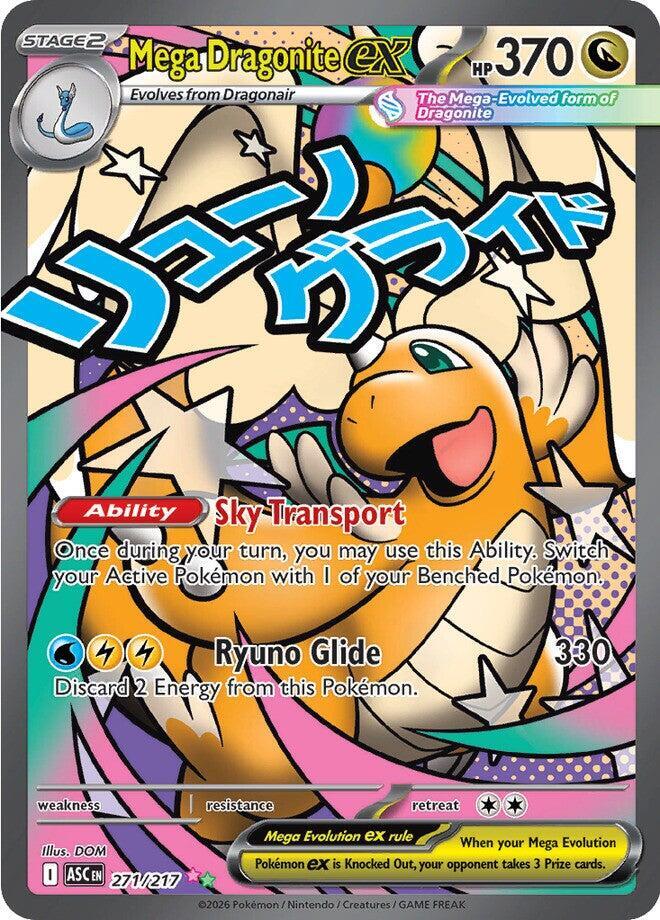
Mega Dragonite ex (#271/217) — Mega Attack Rare, tracking around $55.
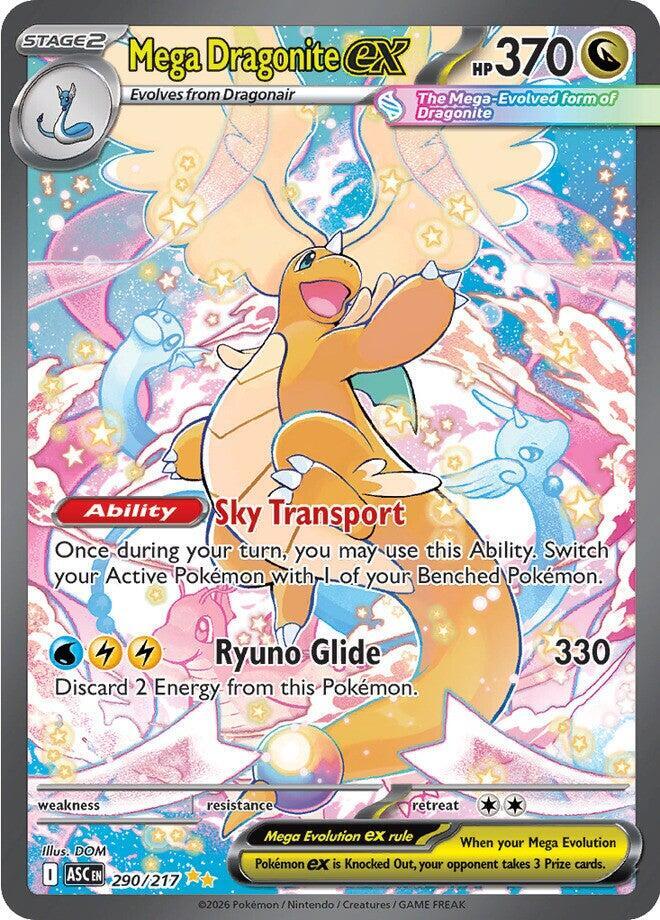
Mega Dragonite ex (#290/217) — Special Illustration Rare, tracking around $875.
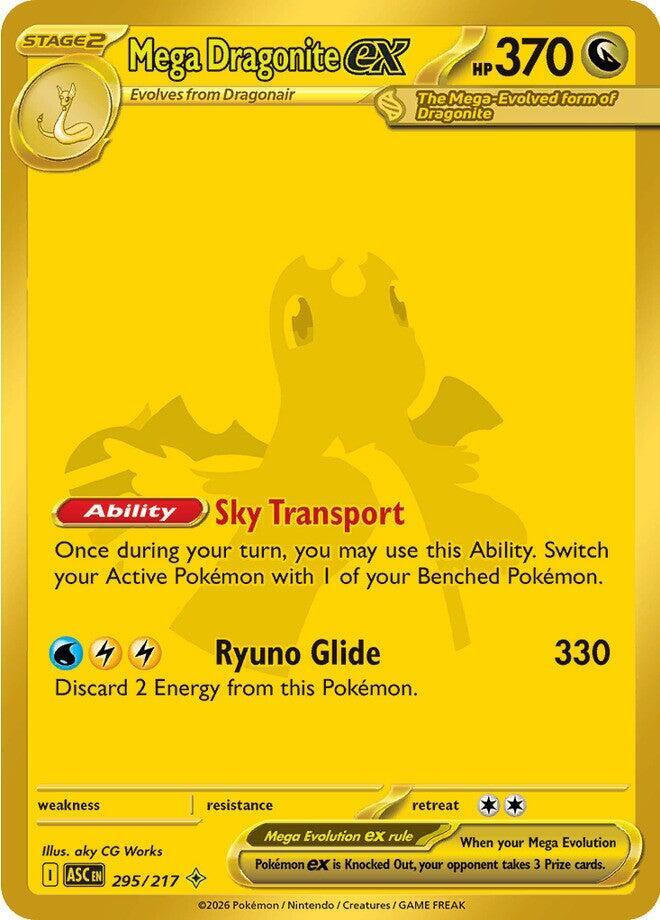
Mega Dragonite ex (#295/217) — Mega Hyper Rare, tracking around $331. Same card, three tiers, and a real illustration of just how steep the jump to Mega Hyper Rare actually is even compared to a Special Illustration Rare of the identical Pokémon.
Mega Attack Rare (MAR) — two stars in a distinctive pink-and-green color scheme, no other rarity uses this combination. Introduced in Ascended Heroes (August 2025), MAR cards feature Mega Pokémon ex, marking Mega Evolution's return to the TCG.
Mega Hyper Rare (MHR) — a gold-embossed treatment of Mega Pokémon ex cards, and by a wide margin the hardest card to pull in the TCG's history. Sets typically print only 2 Mega Hyper Rares, versus roughly 10 regular Hyper Rares — both a steeper per-slot rarity and a much smaller print pool.
A further rarity, described as using an entirely new opalescent effect and breaking from the star-symbol system altogether, is expected with the 30th Celebration set in September 2026 — the first Scarlet & Violet-era rarity to depart from the star hierarchy since it began. Details on its exact symbol aren't confirmed yet.
Why Rarity Isn't Comparable Across Sets
Knowing a card's rarity tells you its scarcity relative to other cards in its own set — it doesn't tell you much when comparing across different sets, because sets vary widely in how many rarities they use and in what proportion. Celebrations, the 2021 25th-anniversary set, contained no Commons, Uncommons, or Rares at all — every card in it was Holo Rare or higher. That skewed floor means even Celebrations' best Ultra Rares sold for less than typical Ultra Rares from Fusion Strike, a set released the same year with a normal rarity spread — the "Ultra Rare" label meant something different depending on which set it came from.
Subsets add another wrinkle: some sets include a smaller pool of cards that can only appear in a specific pack slot, and that subset's rarities are only meaningful relative to each other, not the main set. A card pulled from a subset at a lower-sounding rarity can be dramatically scarcer than a higher-rarity card from the main set it's packaged with.
Even within a single set at a single rarity, print quantities aren't always equal. Card-by-card tracking across thousands of opened packs has found real, repeatable gaps — certain Ultra Rares in the same set showing up roughly four times less often than others at the identical printed rarity, with no way to tell from the symbol alone. The rarity tier is a real, useful signal, but it's not a guarantee of exactly how many of a given card exist.
Real Pull Rates
Rarity | Estimated Rate |
|---|---|
Special Illustration Rare / Hyper Rare | ~1 in 30 to 36 packs, varying by set |
Mega Hyper Rare | ~1 in 1,260 packs — the rarest standard pull in current sets |
These are community-tracked estimates, not official rates published by The Pokémon Company.
One More Wrinkle: Japan vs. English
Japanese sets use their own naming (Triple Rare/RRR in place of Hyper Rare, SAR in place of SIR) and, in practice, distribute their equivalent chase pulls somewhat more generously than English releases of the same set. Japan also releases first — almost every Mega Evolution-era set debuts there months ahead of the English version, which is why chase-card reveals and early sealed-product access often start on the Japanese side. A handful of high-class Japanese sets, like the annual VSTAR Universe or Terastal Festival, never get a direct English release at all.
Pricing: Prices link live to TCGPlayer and update independently of this article.
Affiliate Disclosure: Tome Collective may be compensated if you make a purchase through links in this article.